
Caminito del Rey Flora and Fauna: What We Saw
CAMINITO DEL REY SERIES: ALL 3 PARTS · PART 1 – GETTING THERE · PART 2 – THE WALK
Most people visit Caminito del Rey for the cliffside walkways, but once we slowed down and started looking beyond the path itself, the natural environment became almost as interesting as the walk.
We visited on 14 June 2026, and during our day we saw everything from dry Mediterranean slopes and pine-covered hillsides to flowering oleanders, palms and surprisingly lush vegetation close to the water. The biggest wildlife moments were more unexpected: we saw wild mountain goats and, later, a fox close to the walking route.
This article focuses only on the Caminito del Rey flora and fauna we encountered, together with species and ecological information displayed on the official information boards. Where we personally saw something, we say so. Other animals mentioned below are species described by the official panels rather than animals we are claiming to have seen ourselves.
➜ READ NEXT: PART 1 – GETTING TO CAMINITO DEL REY
➜ READ NEXT: PART 2 – OUR CAMINITO DEL REY WALK
If you want to experience the gorge with a guide, compare current Caminito del Rey tours and entry options here.
CHECK CAMINITO DEL REY TOURS & TICKETS
Quick Facts
Our visit: 14 June 2026
Area: Desfiladero de los Gaitanes Natural Site, Málaga Province
Habitats we noticed: limestone cliffs, rocky slopes, Mediterranean woodland, scrub, river and reservoir environments
Wildlife we personally saw: a fox and wild mountain goats
Most obvious flowering plant during our visit: pink oleander
Officially highlighted wildlife groups: birds of prey, mammals, bats, river species, amphibians and reptiles
Best nature tip: occasionally stop looking at the walkway and scan the cliffs, vegetation and sky
Why Caminito del Rey Supports So Much Wildlife
The dramatic gorge is not one uniform habitat.
As we walked through the area, the scenery repeatedly changed. There were almost vertical rock faces with very little vegetation, dry open hillsides covered in low scrub, shaded woodland, greener areas close to water and sections where shrubs and trees seemed to fill every available space.
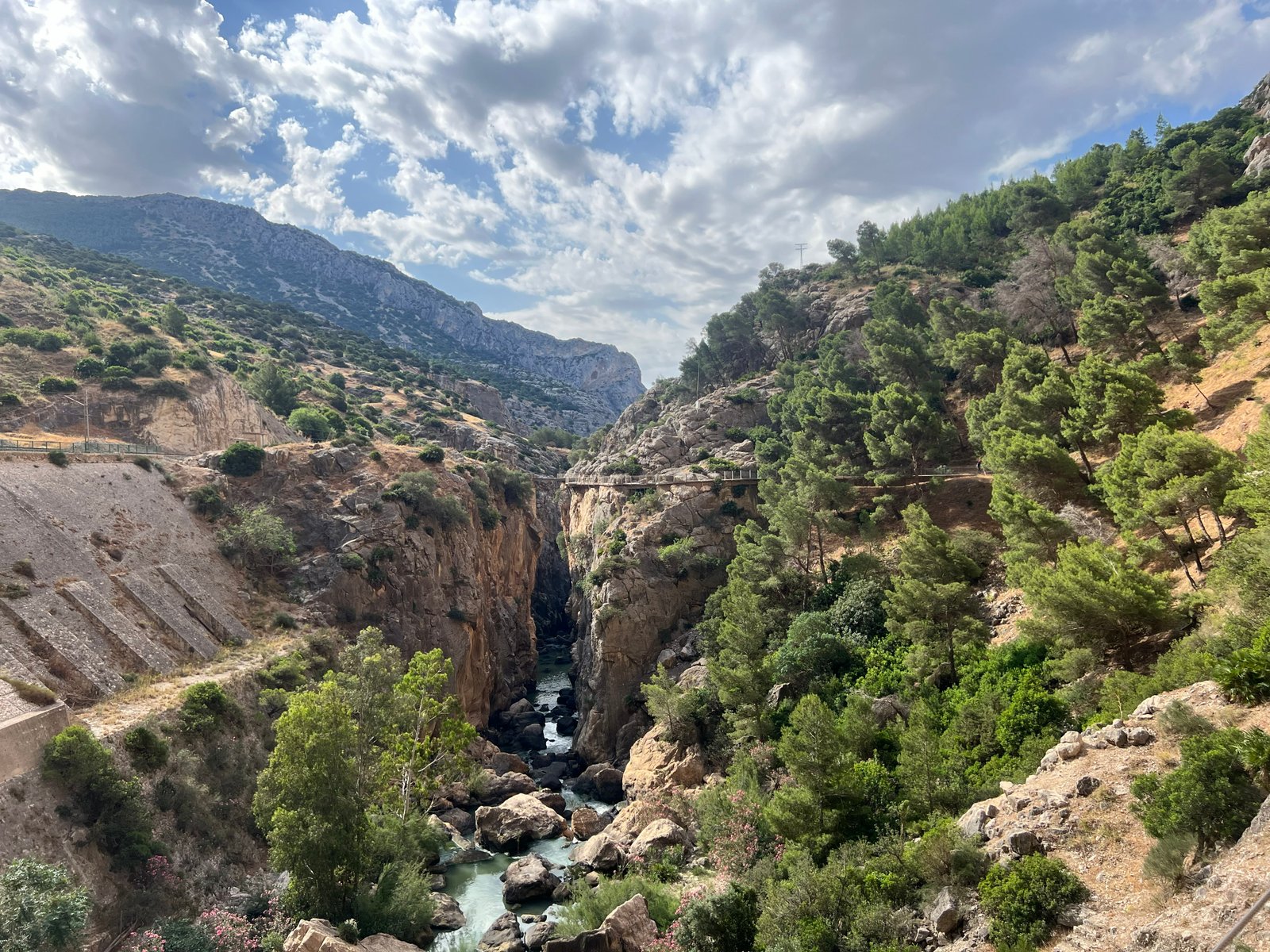
The official fauna information board explains why this mixture matters. It describes a landscape combining rocky areas, woodland, scrub and the Guadalhorce river system, creating a wide range of habitats within a relatively compact area.
The same panel states that the natural area has been designated a Special Protection Area for Birds. It also notes the conservation importance and vulnerability of many species living around Desfiladero de los Gaitanes.
Standing inside the gorge makes this diversity easier to understand. An animal living on an exposed cliff has completely different requirements from one sheltering in woodland or depending on the river below.
The Landscape and Habitats We Observed
The most striking habitat is obviously the rock itself.
Enormous limestone walls dominate Caminito del Rey. Some appear almost completely bare, while others have shrubs and small trees somehow growing from narrow cracks and ledges.
These steep cliffs are particularly important for birds. The official wildlife panel explains that the sheer walls provide nesting places and perches, including habitat used by a significant colony of griffon vultures.
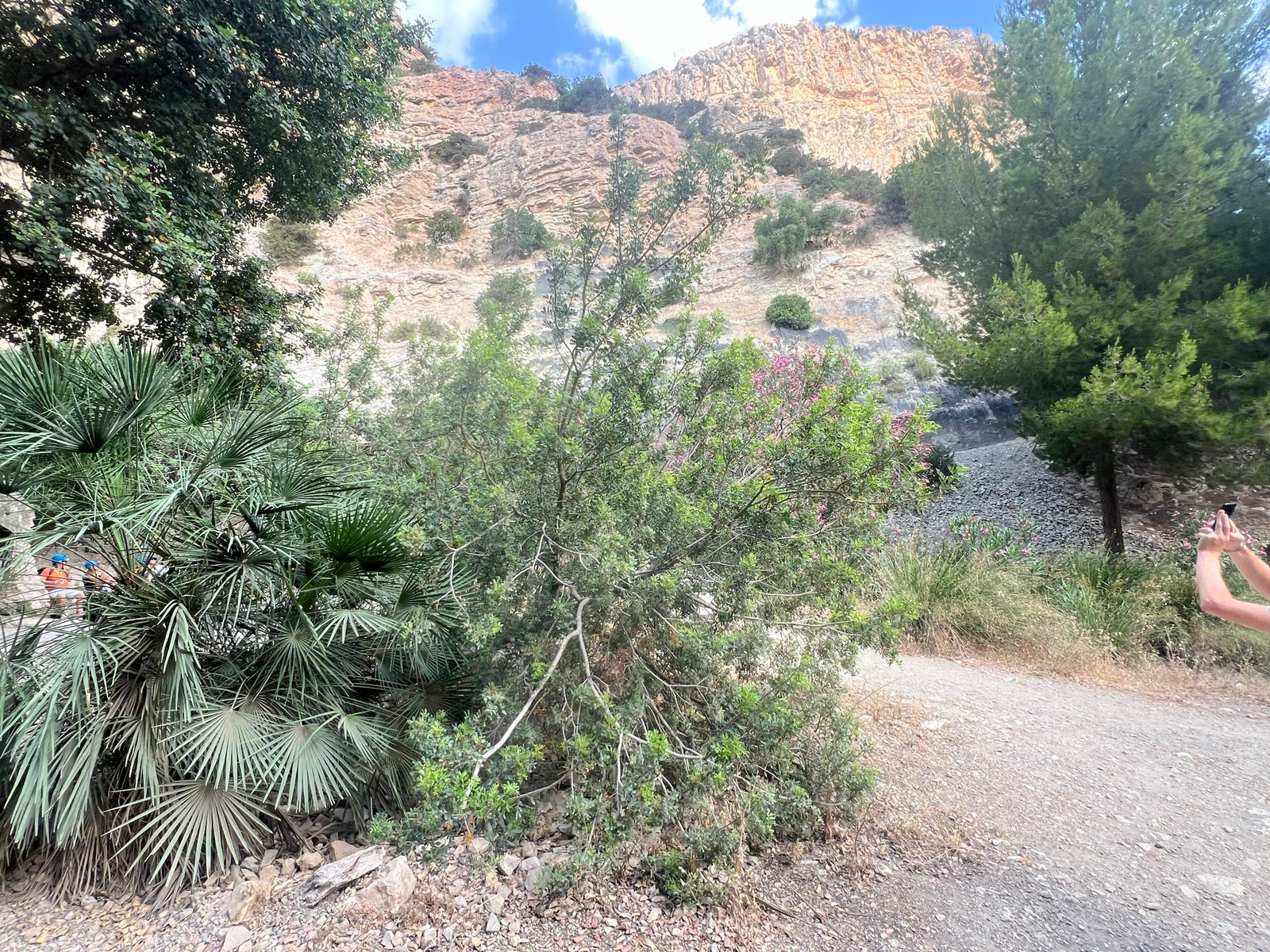
Away from the narrowest sections, the landscape opens considerably. We saw dry grasses, Mediterranean scrub, palms and larger areas of woodland.
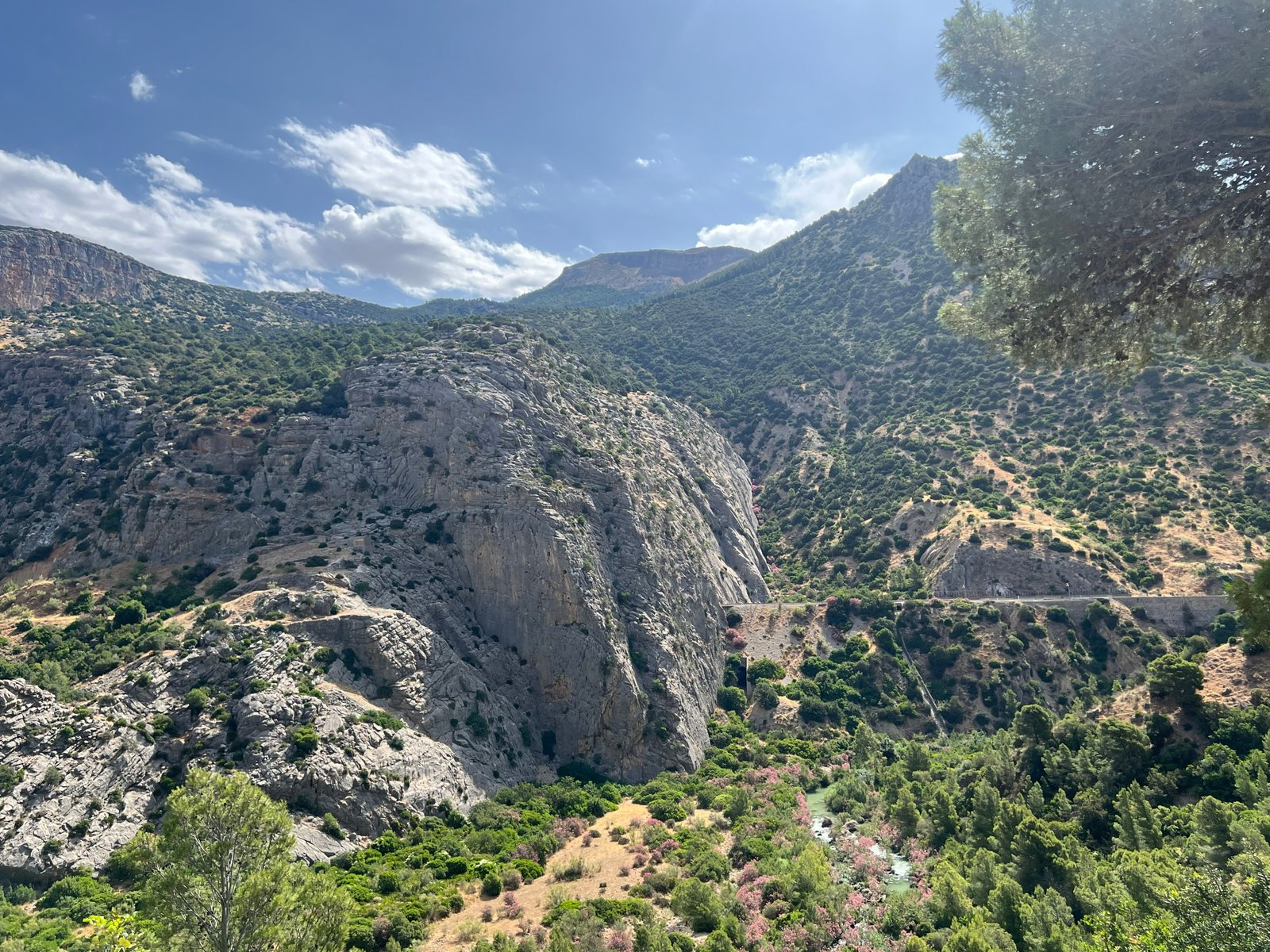
Closer to the water, the difference was obvious. Vegetation became denser and greener, creating another ecological zone beneath the much drier mountain slopes.
The result is that Caminito del Rey never feels like a single landscape. Within one visit, you move visually between gorge, woodland, exposed hillside and river environment.
Plants Along Caminito del Rey
Pink Oleanders Were Everywhere
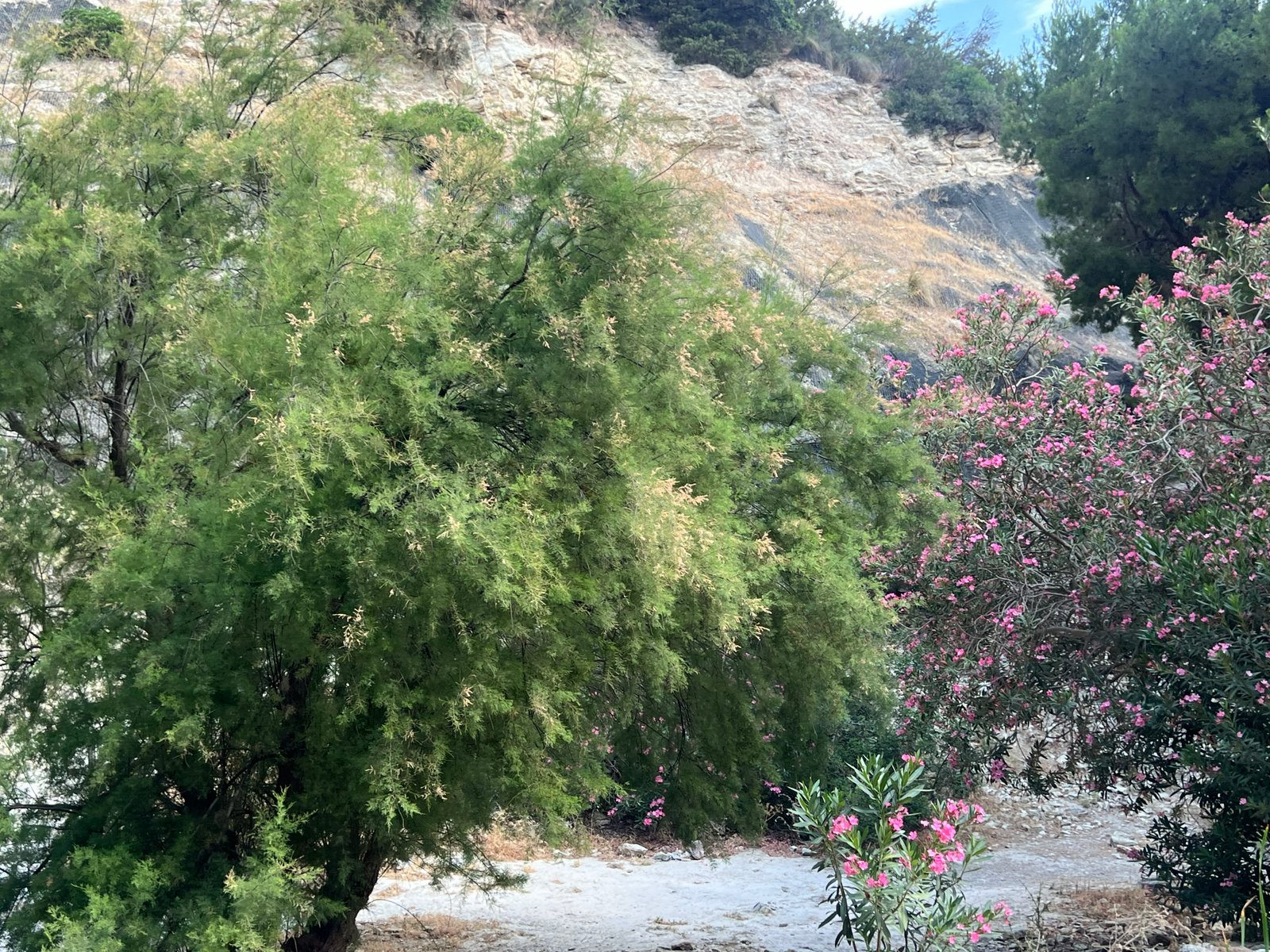
The plant that stood out most during our June visit was the oleander.
Large shrubs covered in bright pink flowers appeared repeatedly, sometimes beside the path and sometimes far below us closer to the water.
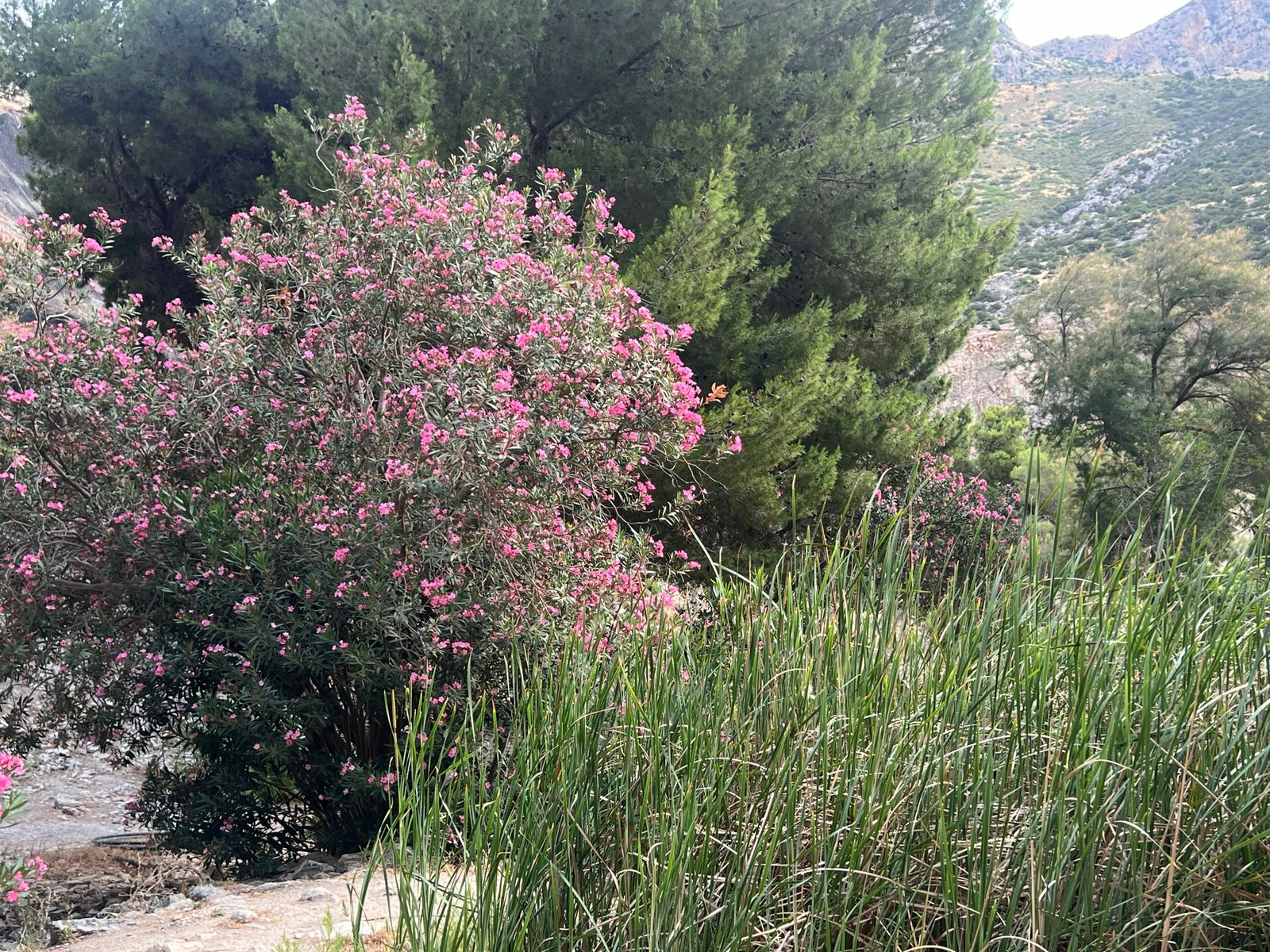
Against the grey and ochre rock, their colour was impossible to miss.
Oleander (Nerium oleander) is well suited to warm Mediterranean environments and is commonly associated with seasonal watercourses and river valleys. At Caminito del Rey, the pink flowers gave us a useful visual clue to where moisture was concentrated in the landscape.
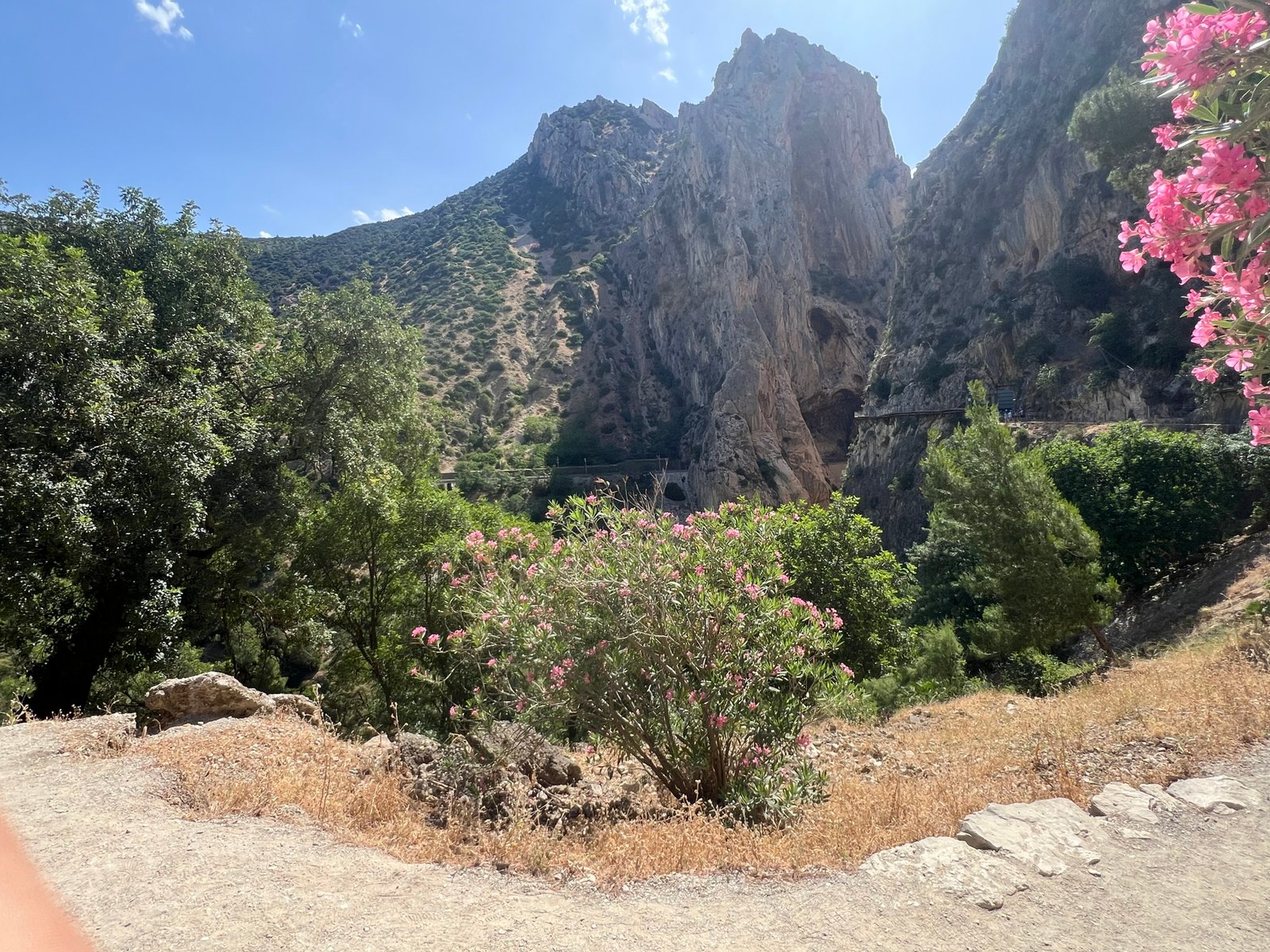
A practical point worth knowing is that oleander is toxic if ingested. There is no reason for visitors to handle any of the plants anyway, but it is another good reason simply to admire the vegetation without picking flowers or leaves.
Mediterranean Pines and Woodland
Another obvious element of the landscape was the pine woodland.
In some places, mature trees provided welcome shade and completely changed the character of the surroundings compared with the exposed cliff sections.
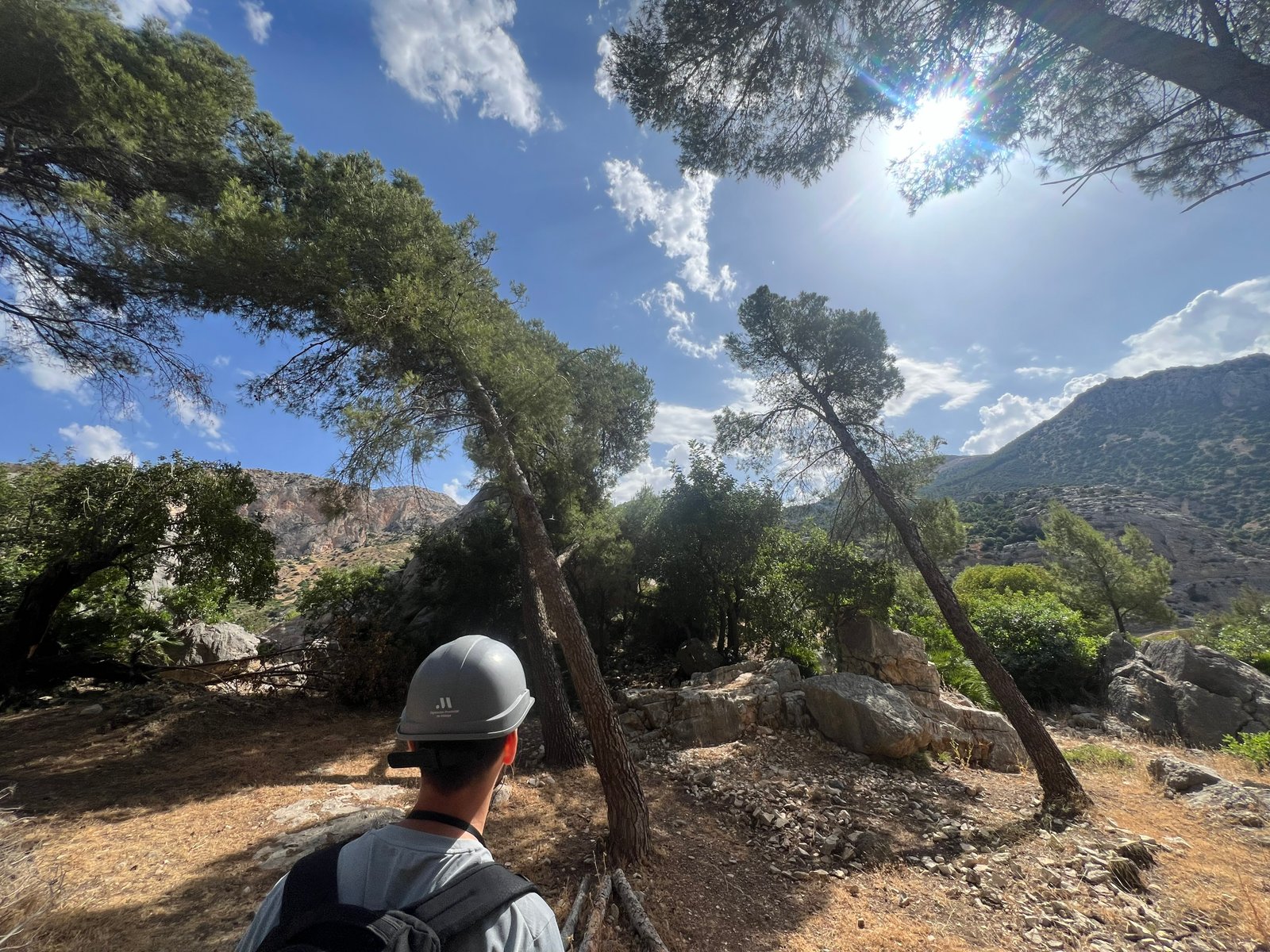
We are deliberately not assigning a particular pine species from our photographs alone. What mattered from a visitor’s perspective was the contrast: dry rocky terrain could suddenly give way to surprisingly established woodland.
Those wooded sections are also important habitat because they provide cover that the exposed rock cannot.
Wild Palms
One of our favourite plants along the route was the low, fan-shaped palm growing naturally among the rocks and scrub.
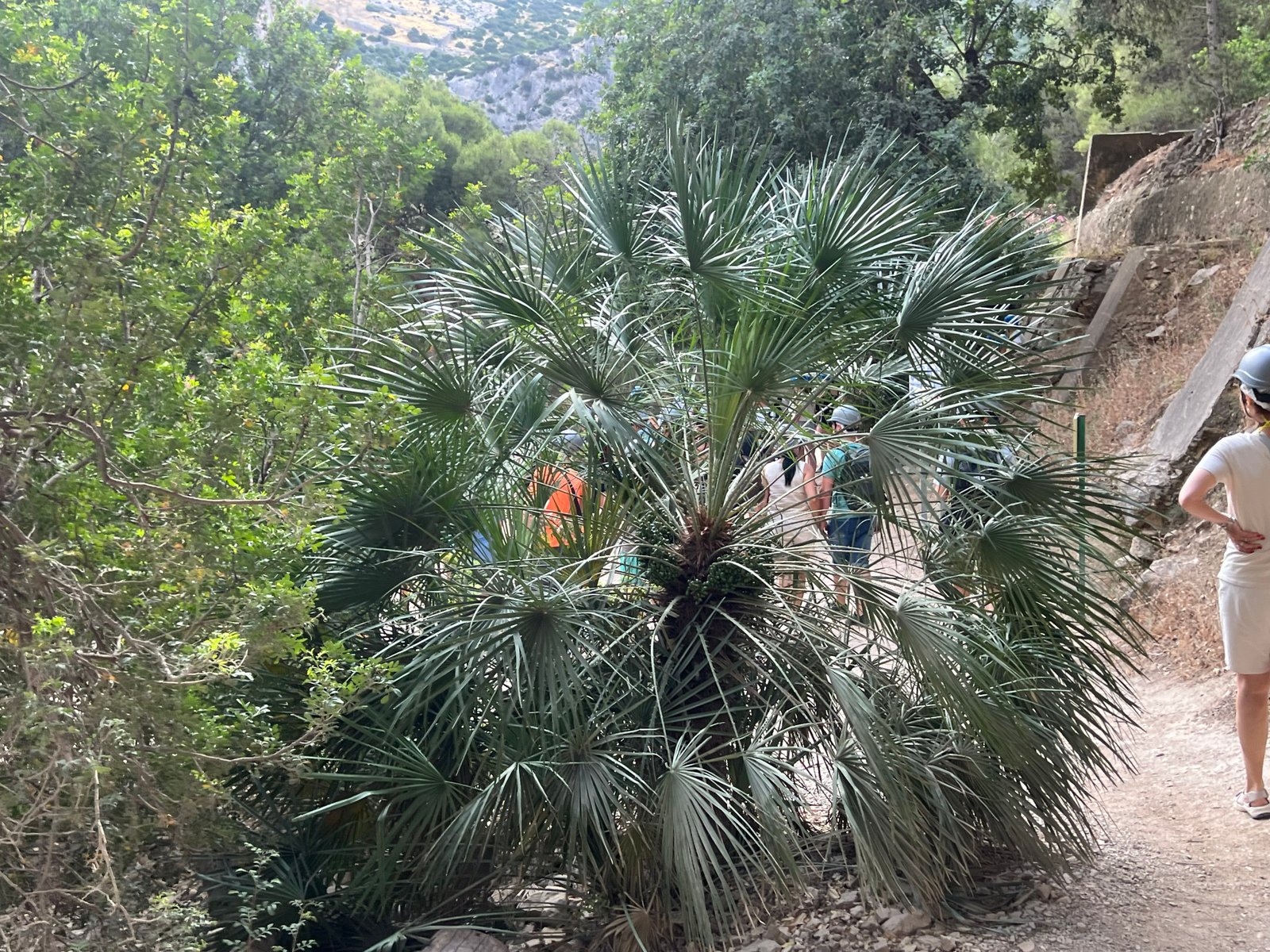
The plants in our photographs are consistent with the European fan palm or dwarf fan palm (Chamaerops humilis), a distinctive Mediterranean species.
Unlike the tall ornamental palms associated with beach promenades, these were compact, dense plants growing naturally in dry rocky terrain.
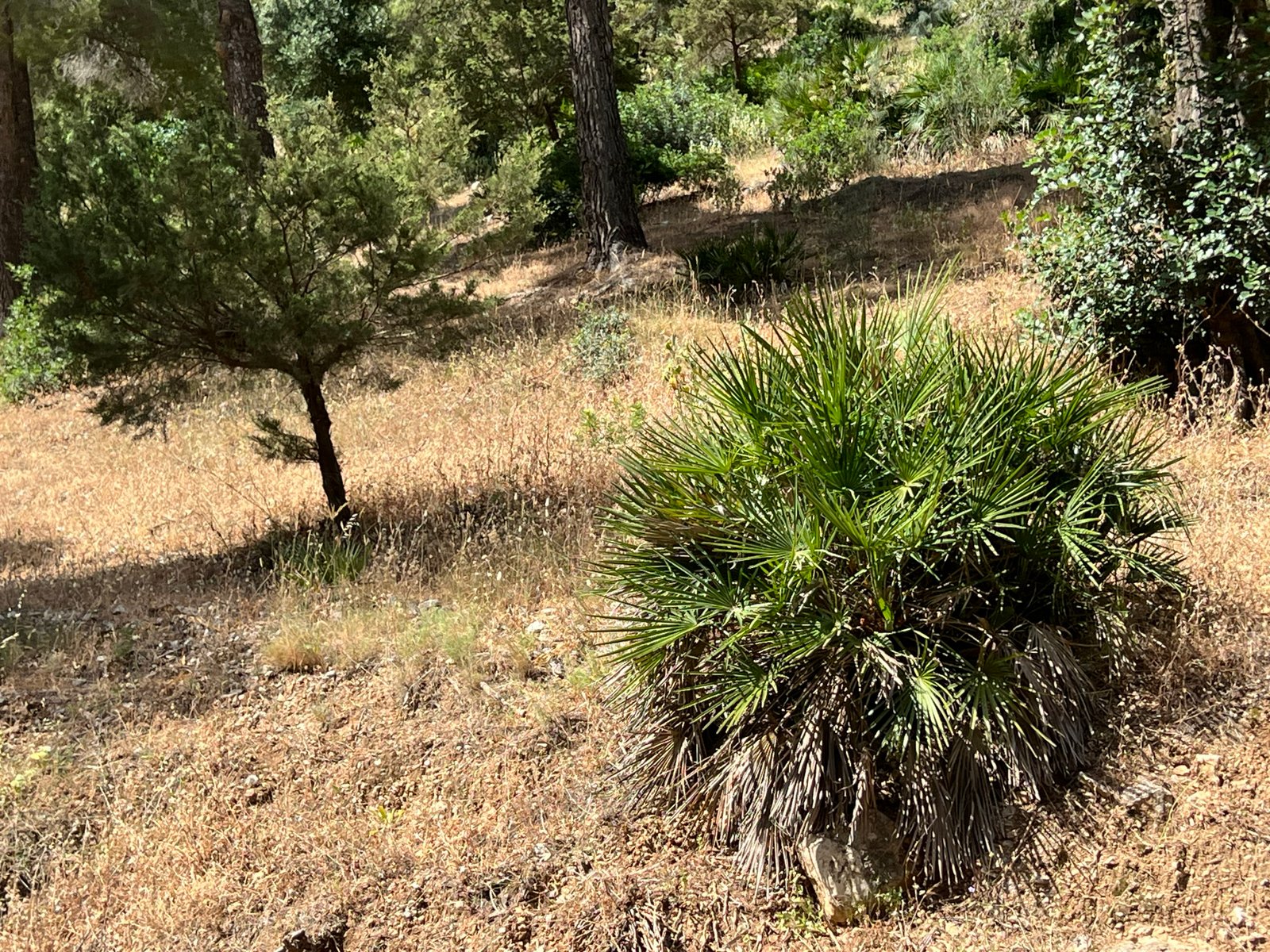
They fitted perfectly into the landscape and were particularly attractive where they appeared beneath larger trees.
A Carob Tree With Large Pods
We also stopped beneath a broad-leaved tree carrying large green pods.
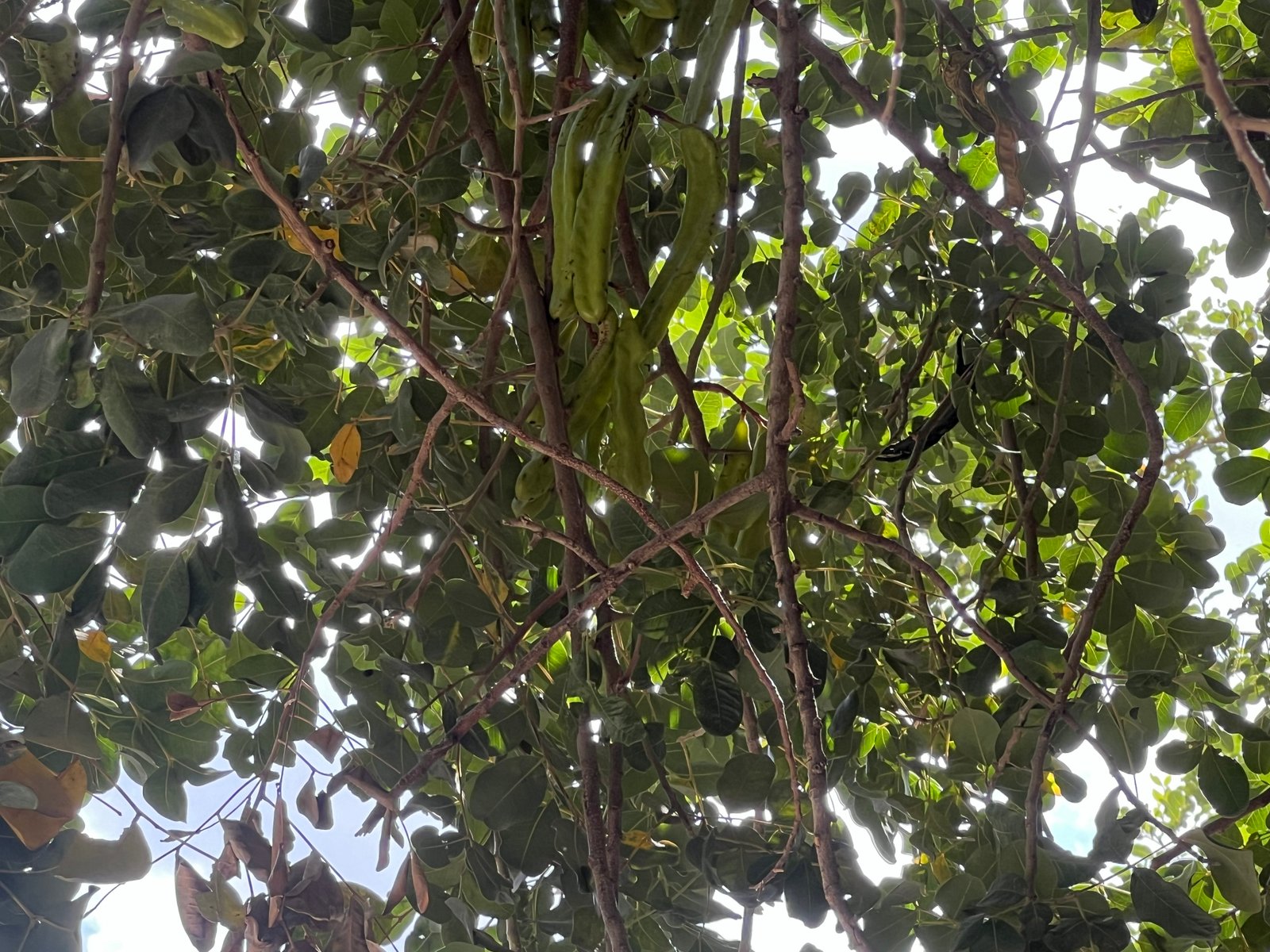
The combination of thick evergreen leaves and long pods is characteristic of a carob tree (Ceratonia siliqua), another tree strongly associated with the Mediterranean.
We enjoyed noticing details like this because they are easy to overlook when most people’s attention is understandably fixed on the gorge.
Caminito del Rey Wildlife We Personally Saw
Our Fox Encounter
Our most memorable wildlife encounter happened when a fox appeared close to the walking route.
It was not hidden hundreds of metres away on a mountainside. It was right near the path, with visitors stopping to watch and photograph it.
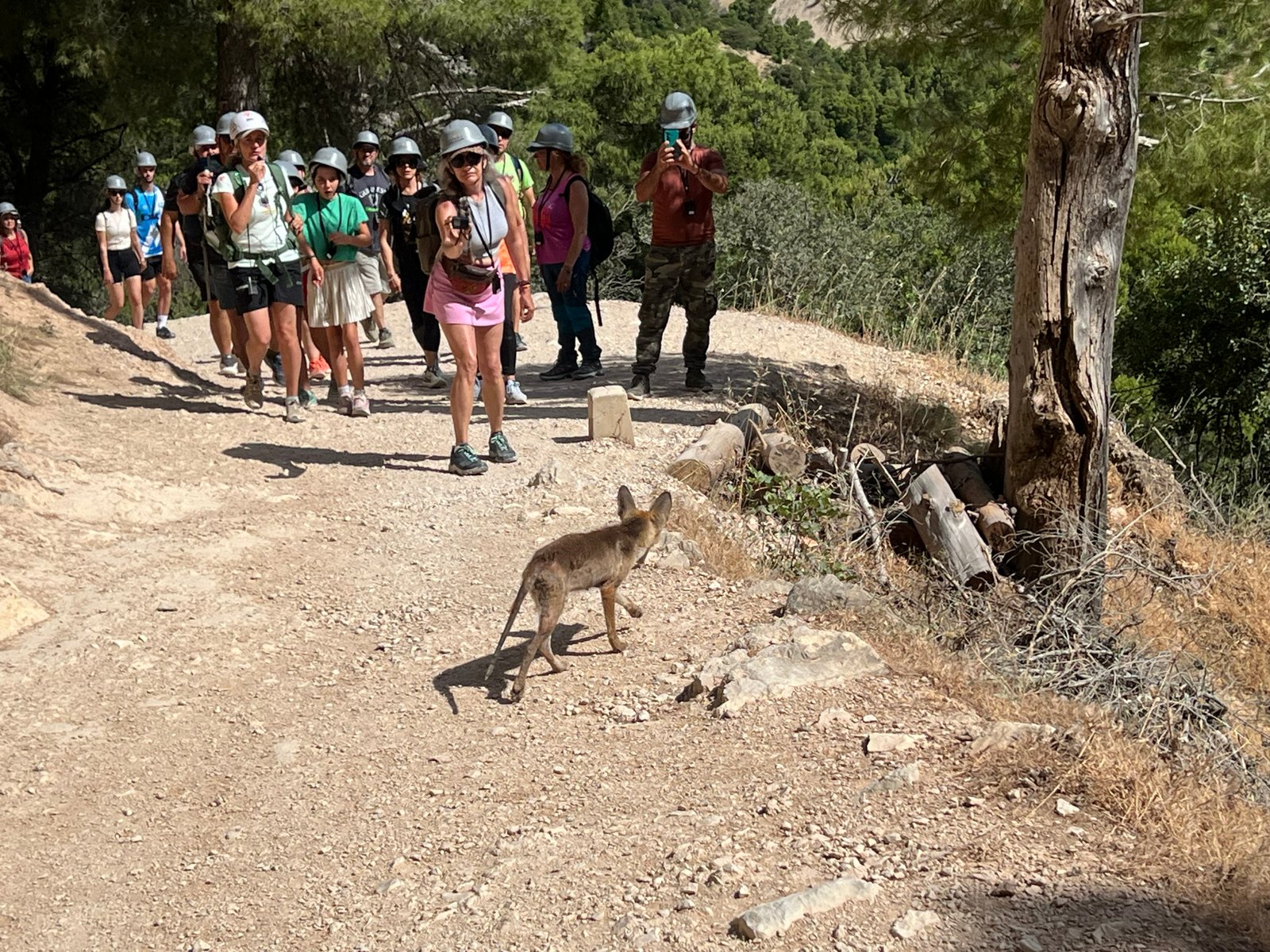
This was one of those moments that completely changed the focus of the walk. For several minutes, nobody cared about cliffs or viewpoints — everyone was watching the animal.
We did not approach or attempt to feed it.
That is important because an animal appearing comfortable around people does not mean it should be treated as tame. The best experience for both visitor and wildlife is to keep a sensible distance and allow the animal to choose where it goes.
Interestingly, foxes are specifically listed on the official Caminito del Rey fauna panel, alongside other mammals known from the area.
Seeing one ourselves therefore connected the information on the sign with the actual landscape in a way we had not expected.
Wild Mountain Goats
We also saw wild mountain goats during our visit.
The official information panel identifies the Spanish ibex (Capra pyrenaica) as one of the notable mammals living in the area.
However, we are keeping our own observation deliberately conservative. We did not examine our animals closely enough to independently confirm their exact species, so we describe what we personally saw simply as wild mountain goats rather than claiming a more precise identification.
That distinction matters in wildlife writing: what you believe an animal probably was and what you can reliably establish are not always the same thing.
Their presence nevertheless made perfect sense. Looking at the steep, broken terrain surrounding the gorge, you can see exactly why agile mountain animals can thrive here.
Birds Listed on the Official Caminito del Rey Wildlife Board
The official fauna panel gives particularly detailed information about birds.
It explains that the rocky cliffs are especially important and identifies the griffon vulture as one of the area’s characteristic species. According to the panel, the cliffs support an important colony, with birds sometimes seen soaring above the gorge or resting on rocky ledges near nesting areas.
The board also lists several other major birds of prey:
- Egyptian vulture
- golden eagle
- Bonelli’s eagle
- peregrine falcon
- Eurasian eagle-owl
It additionally identifies a wider group of birds associated with the surrounding habitats, including red-billed chough, Eurasian jay, black wheatear, common swift, alpine swift, common house martin, Eurasian crag martin, white wagtail, grey wagtail and rock dove.
We are not claiming that we personally identified these birds during our walk. These are species described on the official information board.
If birdwatching is one of your main reasons for visiting, it would be worth spending more time scanning the open sky and rocky ledges rather than expecting birds to appear close to the walkway.
Other Mammals Described on the Information Board
Besides the Spanish ibex and fox, the official panel lists the Egyptian mongoose among the mammals occurring in the area.
It also mentions colonies of bats in some caves.
Again, we did not personally see either during our visit, but their inclusion helps explain how many ecological niches exist around the gorge.
The cliffs contain holes, overhangs and caves, while dense vegetation elsewhere provides a very different form of shelter.
Wildlife Associated With the River
The Guadalhorce river environment creates another important habitat.
The official panel specifically describes the riverbed as suitable habitat for otters and identifies fish including the Andalusian barbel and Pseudochondrostoma willkommii.
We did not see otters, but when looking down towards the water and denser riverside vegetation, it is easy to appreciate how different this environment is from the exposed slopes above.
Water completely changes the vegetation pattern. Near the river and reservoir, trees and flowering shrubs become much more prominent, producing pockets of greenery surrounded by otherwise dry Mediterranean terrain.
Amphibians and Reptiles Mentioned on the Official Panel
The same wildlife board lists several amphibians, including the Spanish painted frog, common toad and Perez’s frog.
For reptiles, it names:
- Spanish pond turtle
- ladder snake
- Andalusian wall lizard
- large psammodromus
We did not personally identify any of these during our visit.
This is also a good example of why looking at the official panels is worthwhile. Many smaller species are easily missed during a busy daytime walk, but that does not mean they are absent from the ecosystem.
How the Gorge Shapes Its Wildlife
Caminito del Rey is an extreme environment in miniature.
At the top of the cliffs, conditions can be hot, dry and exposed. A short distance below, rock faces create shade and cooler microhabitats. At the bottom, flowing water supports a completely different community of plants and animals.
The steepness also protects many areas from human access.
While visitors move along a defined route, huge sections of cliff, woodland and gorge remain effectively inaccessible. That separation is particularly important for nesting birds and larger mammals.
The environment also explains why spotting wildlife can require patience. Many animals have enormous areas of inaccessible terrain available to them and no reason to come close to people.
Our fox encounter was memorable precisely because such close sightings cannot be guaranteed.
Best Opportunities for Observing Wildlife
We would not visit Caminito del Rey expecting a conventional wildlife-watching experience. It is not a safari or a wildlife reserve where animals are routinely visible from observation points.
Instead, nature rewards anyone willing to pay attention.
The places we found most interesting were the transitions between habitats: where open rock meets woodland, where shrubs grow beside the path, and where the view opens down towards water.
Occasionally stop and scan:
- high cliff ledges for large birds;
- open sky above the gorge;
- shaded woodland edges;
- dry slopes for movement;
- riverside vegetation below.
Binoculars would be useful for anyone particularly interested in birds.
Responsible Wildlife Viewing
Seeing a wild animal close to the route is exciting, but visitors should avoid changing its behaviour.
Do not feed wildlife, chase animals for photographs or leave the designated visitor areas. Feeding is particularly problematic because animals can quickly associate people with food and lose their natural caution.
The same principle applies to plants.
Do not pick flowers, remove seeds or damage vegetation, even when a plant appears common. The official safety information around Caminito del Rey repeatedly emphasises respecting the protected environment.
Take photographs and leave everything else where you found it.
Practical Nature Tips
June was already hot, so much of the wildlife was unlikely to be active in exposed areas during the warmest parts of the day. An earlier walk may offer better chances of seeing movement while temperatures are lower.
For anyone particularly interested in the Caminito del Rey flora and fauna, we would also recommend bringing binoculars, keeping your camera accessible rather than buried in a backpack, and allowing yourself time to look away from the famous walkway.
Don’t forget sun protection and water either. Watching birds or searching the cliffs for wildlife inevitably means spending more time standing in exposed places.
Pros & Cons From a Nature Perspective
Pros
- Several distinct habitats within one relatively compact area
- Excellent opportunities to observe Mediterranean vegetation
- Important cliff habitat for birds of prey
- Possibility of unexpected mammal sightings
- Dramatic geology makes the ecological setting easy to appreciate
- Official information boards provide useful species information
- River, woodland, scrub and cliffs can all be seen during the same visit
Cons
- Wildlife sightings are never guaranteed
- Large visitor numbers can make quiet observation difficult
- Many animals remain far away on inaccessible cliffs
- Midday heat can reduce wildlife activity
- The walkway is primarily designed for visitors, not specialist wildlife observation
FAQ
What wildlife can you see at Caminito del Rey?
We personally saw a fox and wild mountain goats. The official information board also identifies Spanish ibex, Egyptian mongoose, bats, otters and numerous birds, reptiles, amphibians and fish as part of the local fauna.
Are there vultures at Caminito del Rey?
Yes. The official fauna panel states that the rocky cliffs support a significant colony of griffon vultures.
Are there eagles?
The official board lists golden eagle and Bonelli’s eagle, as well as Egyptian vulture and peregrine falcon. We did not personally identify these species during our visit.
What plants did you notice?
The most obvious plants during our June visit were flowering oleanders, Mediterranean woodland, fan palms and a carob tree carrying large pods.
Did you really see a fox?
Yes. We personally saw and photographed a fox close to the walking route.
Did you see Spanish ibex?
We saw wild mountain goats. The official information board lists Spanish ibex as a local species, but we cannot confidently establish that the animals we personally saw were Spanish ibex, so we prefer not to make that identification as fact.
Is Caminito del Rey good for birdwatching?
The landscape is clearly important for birds, particularly cliff-nesting species. However, this is a busy visitor attraction rather than a dedicated birdwatching site, so binoculars and patience would be useful.
For a guided walk with official guides and entry included, this is the type of experience we used for our visit.
BOOK A CAMINITO DEL REY GUIDED TOUR
Final Thoughts on Caminito del Rey Flora and Fauna
The cliffs are what initially draw your attention at Caminito del Rey, but the natural environment becomes much more interesting once you begin noticing what lives between, above and below them.
During our own visit, seeing wild mountain goats and a fox gave the day an unexpected wildlife element, while the oleanders, palms, pine woodland and changing vegetation showed just how varied the gorge really is.
Reading the official fauna panel afterwards added another layer. Griffon vultures, eagles, bats, otters, reptiles, amphibians and other mammals all form part of an ecosystem far richer than you might assume when first looking at the bare limestone walls.
For us, that is the most interesting thing about Caminito del Rey flora and fauna: you don’t need to turn the visit into a dedicated nature expedition. Simply paying attention to the cliffs, sky, vegetation and water reveals a completely different side of the place.
Travel Insurance and Car Rental
For trips like this, we prefer to have travel insurance in place before we leave. It gives us extra peace of mind if plans change or something unexpected happens while we are away.
READ NEXT: OUR TRAVEL INSURANCE GUIDE
If you are exploring Andalucía independently, a rental car makes it much easier to combine Caminito del Rey with other places in the region.
READ NEXT: OUR SPAIN CAR RENTAL EXPERIENCE