
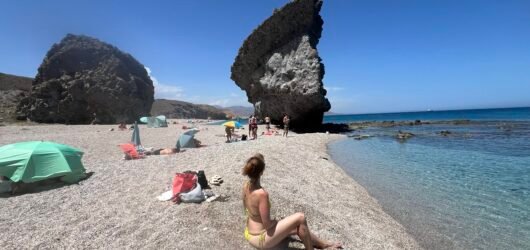
Playa de los Muertos: Our Complete Guide to One of Almería’s Most Striking Beaches
There is no promenade leading down to the water, no row of beach bars and no convenient road ending beside the sand. Instead, you leave the car above the coast and make your way down through the dry, rugged landscape of Cabo de Gata-Níjar Natural Park.
For us, that approach was part of the experience. From the higher ground, the Mediterranean appears between the hills as a deep strip of blue. As you descend, more of the coastline gradually comes into view until you finally reach the pale beach and remarkably clear water below.
Playa de los Muertos is near Carboneras in Almería, in south-eastern Spain. The protected landscape around it is stark rather than lush: volcanic rock, dry hillsides, scrub and an intensely blue sea. The Junta de Andalucía describes Playa de los Muertos as one of the largest beaches in Cabo de Gata-Níjar Natural Park and highlights its transparent turquoise water and volcanic formations.
It is not the easiest beach in Spain to visit. But if you are comfortable with the walk and arrive properly prepared, it is one of those places where the effort genuinely adds to the experience.
Playa de los Muertos Quick Facts
Location: Near Carboneras, Almería, Andalucía, Spain
Natural area: Cabo de Gata-Níjar Natural Park
Best for: Swimming, snorkelling, dramatic scenery and photography
Beach type: Natural, exposed beach rather than an urban resort beach
Access: On foot from the parking/access area above the coast
Footwear: Proper sandals or trainers are much better than flimsy flip-flops for the descent
Shade: Very limited natural shade
Facilities on the beach: Do not expect normal resort-beach facilities
Water: Exceptionally clear when conditions are calm
Family suitability: Better for older children and confident walkers than families carrying lots of equipment or using pushchairs
Our main advice: Travel light, take plenty of water and do not underestimate the walk back uphill.
The official Andalucía tourism information confirms access from the AL-5106 and a path from the Los Muertos information/viewpoint area towards the beach.
Where Is Playa de los Muertos?
Playa de los Muertos lies on the Almería coast close to Carboneras, on the eastern side of Cabo de Gata-Níjar Natural Park.
This matters because the surroundings feel very different from the built-up Mediterranean resorts found elsewhere in Spain.
There are no high-rise hotels behind the beach and no seafront road separating the water from a town. Instead, the beach sits below a harsh, semi-arid landscape dominated by hills and exposed rock.
Even before reaching the water, the landscape tells you that this is going to be a different kind of beach day.
The official natural park information also explains some of the geology visible here. Dark volcanic material around Punta de los Muertos is estimated to be around 9–16 million years old, while the lighter material includes bioclastic sediments containing remnants of marine organisms such as molluscs and algae.
You do not need to be interested in geology to enjoy the beach, but knowing this does help explain why the scenery looks so unusual.
READ NEXT: SPAIN CAR RENTAL / CENTAURO – OUR EXPERIENCE
COMPARE CAR RENTAL PRICESParking at Playa de los Muertos
If you are driving, your Playa de los Muertos experience effectively begins at the parking area above the coast.
When we visited, there were plenty of cars, and it was immediately obvious that this is not some completely unknown beach. Its isolated appearance can be misleading: Playa de los Muertos is well known and summer visitors do come here specifically to see it.
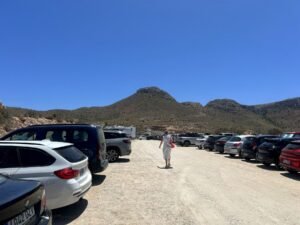
The important thing to understand is that parking does not mean you have arrived at the beach.
You still have to walk down.
That affects what you should take with you. Carrying a small backpack, water and snorkelling equipment is manageable. Carrying several heavy bags, large cool boxes, bulky chairs and everything needed for a full family beach camp is another matter entirely.
Whatever you carry down eventually has to come back up.
That sounds obvious, but after several hours in strong Almería sunshine, the uphill journey can feel considerably longer than the descent.
Arrive Earlier in High Season
If visiting during the busiest summer period, we would arrive reasonably early rather than assuming you can turn up at the most popular time of day and have the easiest experience.
It also makes sense from a temperature perspective. The landscape is very exposed and there is little shade on the approach.
The Walk Down to Playa de los Muertos
This is the part of visiting Playa de los Muertos that deserves more attention than it sometimes receives.
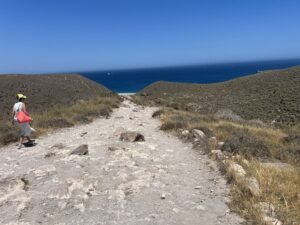
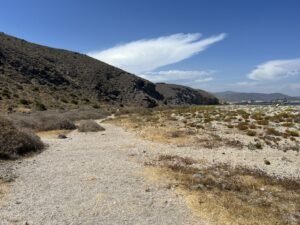
It is a real descent through rough, dry terrain, not a short stroll from a beachfront car park.
Near the beginning, the route feels relatively straightforward.
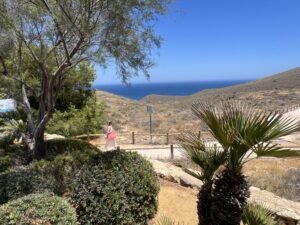
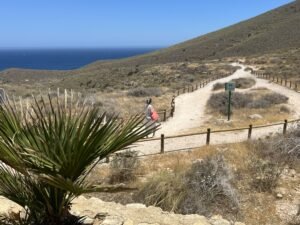
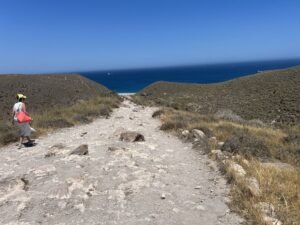
You walk through a landscape of low vegetation, dusty paths and bare hills, with wooden barriers helping define parts of the route.
The Mediterranean soon becomes visible ahead.
At first it appears as a distant blue horizon. Continue walking and the beach gradually reveals itself between the hills.
This was one of our favourite parts of the visit.
You can already see why Playa de los Muertos attracts so much attention, but you are still separated from it by the rugged terrain below. The contrast between the dry brown landscape and the blue Mediterranean is superb.
As the descent becomes rougher, the path demands more concentration.
Loose stones and uneven sections make sensible footwear worthwhile. We would not choose slippery beach flip-flops for this part of the journey.
The route is perfectly manageable for many reasonably mobile visitors, but describing Playa de los Muertos as an easily accessible beach would be misleading.
If someone in your group has reduced mobility, struggles on steep or uneven ground, or needs a pushchair, this is probably not the right beach.
Stay on the Marked Paths
This is also a protected natural environment, not simply an open hillside where visitors should create their own shortcuts.
We saw official signs explaining restoration work and asking visitors to remain on the established paths. The notice warns that shortcuts damage vegetation, contribute to soil erosion and fragment the habitat.
That is worth respecting.
The natural park authorities have carried out restoration work around Playa de los Muertos and other sensitive areas of Cabo de Gata-Níjar, reinforcing the importance of using designated routes rather than cutting across the terrain.
The First View of the Beach
There is a point on the descent where the beach finally becomes clearly visible far below.
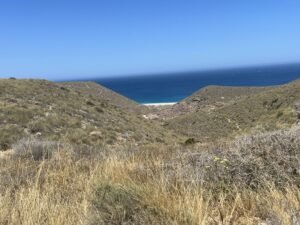
This is where the scale of the landscape becomes apparent.
The sea looks almost unreal against the dry hills, with the pale strip of beach squeezed between them.
It is also the moment when you realise exactly how far you have descended – and therefore how far you will eventually have to climb back.
Still, the view makes a convincing argument for continuing.
Arriving at Playa de los Muertos
Once you reach beach level, the character of the place changes.
The enclosed descent suddenly opens into a broad stretch of pale shoreline backed by dark hills and rock formations.
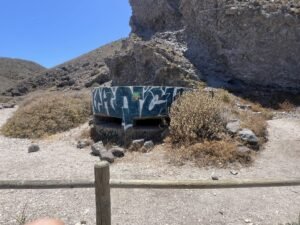
Do not expect a perfectly soft, fine-sand beach. The surface is coarser and more natural in character, with small stones and shell-like material in places.
For us, that suited the surroundings.
A manicured resort beach would almost feel wrong here.
The scale also means that even when there are other visitors around, parts of the beach can still feel spacious.
The Water at Playa de los Muertos
This is the strongest reason to make the journey.
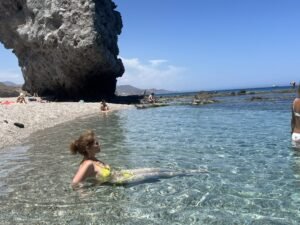
On our visit, the water was exceptionally transparent.
Close to shore, we could see the seabed clearly through the surface.
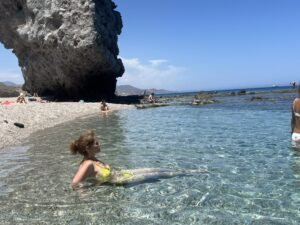
As the light changed, the colours shifted between transparent, pale turquoise and deeper blue.
There is a difference between describing water as “blue” and actually being able to look through it and see the texture of the bottom.
Playa de los Muertos gave us the second experience.
The official description from the Junta de Andalucía similarly characterises the beach as having transparent turquoise water.
Swimming at Playa de los Muertos
When conditions are calm, swimming here can be excellent.
We spent time both swimming and simply relaxing in the shallower water close to the rocks.
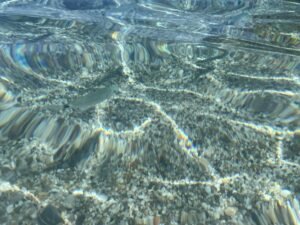
The clarity makes the water particularly inviting, and on our visit it was possible to see the bottom around us very easily.
However, this is an open natural coastline rather than a sheltered hotel lagoon. Sea conditions can change.
Do not assume that photographs taken on a calm day represent the water every day of the year.
Check the sea when you arrive, pay attention to any local warnings and use normal judgement before swimming, particularly if waves or currents appear stronger than expected.
During summer, authorities also use temporary marine-zone measures at Playa de los Muertos and other natural beaches in Cabo de Gata-Níjar to help protect coastal habitats and manage recreational use.
Is Playa de los Muertos Good for Snorkelling?
Yes – when the sea is calm, we think bringing a mask is worthwhile.
The combination of clear water and rocky sections creates much more visual interest than you get from swimming over featureless sand.
We were able to see small fish in the shallow water.
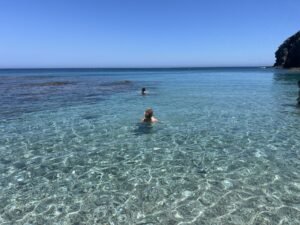
This is exactly the sort of simple snorkelling we enjoy on a beach trip: no organised excursion, no boat and no complicated equipment required.
A mask and snorkel are enough to explore gently from shore when conditions allow.
Visibility will obviously vary with wind, waves and recent weather, so nobody can guarantee crystal-clear snorkelling conditions on a particular day.
The Rock Formations
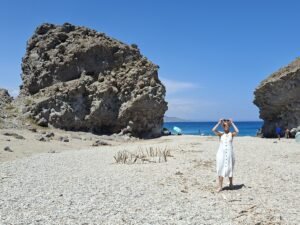
At one end of Playa de los Muertos, enormous detached volcanic formations dominate the shoreline.
They are one of the defining visual features of the beach.
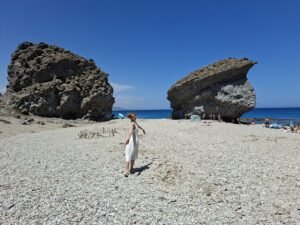
The official park information describes two volcanic masses detached from the cliffs at the entrance to the beach.
Standing beside them gives you a much better sense of scale than photographs taken from farther away.
They also make this section particularly photogenic, with dark rock, pale shoreline and blue water all in the same frame.
This was one of the areas where we spent the most time.
If you enjoy photography, do not simply reach the beach, put your towel down and stay in one place. Walk along the shoreline and explore the different perspectives.
We always feel more relaxed travelling when we know we are insured, especially when exploring remote beaches by car. READ NEXT: TRAVEL INSURANCE – WHAT WE USE AND WHY
Does Playa de los Muertos Have Facilities?
This is where Playa de los Muertos differs significantly from a typical urban Spanish beach.
Come expecting a natural beach, not a resort beach.
Do not base your visit on the assumption that you will have a café, restaurant, sunbed rental, shop, shower and every other convenience beside your towel.
The official visitor information identifies a small information kiosk in the area near the Punta de los Muertos viewpoint/access point, rather than describing a developed beachfront service area.
For practical purposes, we would bring everything essential with us.
What to Take to Playa de los Muertos
We recommend bringing:
- Plenty of drinking water
- Sun cream
- A hat
- Sunglasses
- Food or snacks
- A beach towel
- A small umbrella or other portable shade if needed
- Mask and snorkel
- Water shoes if you prefer them on coarse beach surfaces
- Comfortable footwear for the descent and return climb
- A bag for taking all your rubbish back with you
Most importantly, balance preparation against weight.
You need enough water and sun protection, but there is little benefit in carrying half your house down the hill.
Shade and the Almería Sun
Shade is another important consideration.
The landscape around Playa de los Muertos is dry and exposed. On a hot, cloudless day, the sun can be intense.
There are rock formations, but we would not plan a full day around finding reliable natural shade beside them. Rock faces can also present hazards, including falling material, so choose your resting place sensibly rather than pressing yourself directly against cliffs for shade.
A compact beach umbrella can therefore be useful if you plan to stay for several hours.
And take more water than you think you will need.
The climb back to the car is precisely when that extra bottle becomes valuable.
When Is the Best Time to Visit Playa de los Muertos?
There is no single perfect month because the best time depends on what you want from the visit.
Summer
Summer offers the classic Mediterranean beach experience, but it also means stronger heat and potentially more visitors.
If travelling in July or August, we would favour earlier in the day rather than beginning the descent during the hottest part of the afternoon.
Late Spring and Early Autumn
For many travellers, these periods may provide a better balance between pleasant weather and easier walking conditions.
However, sea temperature, wind and weather vary, so check the forecast rather than relying purely on the calendar.
Calm Days Matter More Than Perfect Dates
If swimming and snorkelling are your priorities, actual sea conditions matter enormously.
We would choose a calm day over chasing a supposedly perfect month.
Playa de los Muertos Pros & Cons
Pros
Spectacularly clear water
The clarity was the standout feature of our visit.
Excellent natural scenery
The combination of dry hills, volcanic rock and turquoise Mediterranean water is distinctive.
Good snorkelling potential
When conditions are calm, the clear shallow water and rocky sections make bringing a mask worthwhile.
Feels genuinely different from a resort beach
There are no hotels and promenades dominating the immediate landscape.
Excellent photography
The descent, coastline, water and large rock formations provide plenty of strong viewpoints.
Cons
The access is not easy for everyone
You need to walk down uneven terrain and then climb back.
Very exposed to the sun
Shade is limited.
Not a full-service beach
Bring what you need rather than expecting resort-style facilities beside the water.
You have to carry everything
Every bottle, towel, snorkel and umbrella that goes down has to come back up.
Not ideal for reduced mobility
The terrain is the main limitation.
READ NEXT: CAMINITO DEL REY – OUR FIRST-HAND GUIDE
Our Practical Tips for Visiting Playa de los Muertos
The biggest mistake would be treating Playa de los Muertos exactly like an urban beach.
Travel reasonably light. Wear proper footwear for the descent. Take enough water. Bring snorkelling gear if the forecast looks calm. Protect yourself from the sun.
And leave enough energy for the return.
We would also allow enough time to enjoy the place rather than rushing down for a photograph and immediately climbing back.
Part of the appeal is swimming along the clear shoreline, exploring the rocks and seeing the beach from several different angles.
Is Playa de los Muertos Worth Visiting?
For us, yes.
But it depends on what you want from a beach.
If your ideal day means parking five metres from the sand, hiring a sunbed and walking to a beach bar for lunch, there are much easier places to choose.
If you value clear water, dramatic natural landscapes and beaches that require a little effort to reach, Playa de los Muertos is much more interesting.
The walk is not an inconvenience that should be hidden from visitors. It is part of the character of the place.
You leave the cars and road behind, descend through an increasingly wild landscape and watch the Mediterranean slowly appear below you.
Then you reach water clear enough to see the stones beneath your feet.
That combination is what we remember most.
FAQ: Visiting Playa de los Muertos
Where is Playa de los Muertos?
Playa de los Muertos is near Carboneras in the province of Almería, Andalucía, on Spain’s south-eastern Mediterranean coast. It lies within Cabo de Gata-Níjar Natural Park.
Can you drive directly to Playa de los Muertos?
No. You drive to the access/parking area and continue to the beach on foot. Official visitor information confirms that a path from the Los Muertos information area leads towards the beach.
Is the walk to Playa de los Muertos difficult?
It depends on your mobility and experience. Parts of the route are uneven and rocky, and the return involves climbing uphill. For reasonably fit visitors it is manageable, but it is not comparable to walking along a flat promenade.
Can you swim at Playa de los Muertos?
Yes, when conditions are suitable. We swam there and found the water extremely clear. However, it is an exposed natural beach, so always judge the conditions on the day and follow local warnings.
Is Playa de los Muertos good for snorkelling?
It can be very good when the water is calm. The visibility during our visit was excellent, and we saw small fish in the shallows.
Is Playa de los Muertos sandy?
Do not expect soft resort-style sand. The shore has a pale, coarse texture with small stones and bioclastic material. Official geological information describes the lighter sediments as bioclastic sands formed partly from marine-organism remains.
Are there restaurants on Playa de los Muertos?
We would not rely on finding beachfront restaurants or cafés. Treat it as a natural beach and bring your own water and food.
Are there toilets at Playa de los Muertos?
Do not plan your visit on the assumption that full beach facilities will be available beside the sea. Facilities and seasonal services can change, so check locally at the access/information area if this is important to you.
Is Playa de los Muertos suitable for children?
That depends much more on the child than on age alone. The main issue is the descent and uphill return. Families with older children who are confident walkers may find it manageable; pushchairs and very young children make the logistics considerably harder.
What should I wear for the walk?
We recommend trainers, walking sandals or another shoe with decent grip. You can change into water shoes or go barefoot once you reach the beach.
Why is it called Playa de los Muertos?
According to the Junta de Andalucía, the name is associated with people who died in shipwrecks and whose bodies were carried towards this part of the coast by prevailing currents.
Is Playa de los Muertos inside a protected area?
Yes. It is part of Cabo de Gata-Níjar Natural Park and is classified among the park’s coastal recreational areas, where visitor use is managed alongside protection of the landscape and natural values.
Final Thoughts
Playa de los Muertos is not beautiful because someone has made it convenient.
It is beautiful largely because they have not.
There is a car park above the coast and an established route down, but once you begin walking, the landscape quickly takes over. Dry hills surround you, the road disappears and the Mediterranean gradually fills the view.
At beach level, the reward is simple: dramatic rock formations, a broad natural shoreline and some of the clearest water we encountered in this part of Spain.
Our advice is equally simple: wear decent shoes, carry plenty of water, take a snorkel and keep your beach bag light.
Then take your time.
Playa de los Muertos deserves more than a quick photograph.